France’s state-aviation accident bureau, the BEA-É, has published safety investigation report S-2025-12-I. It covers a serious incident on November 18, 2025, involving an Airbus H145 flown by the Sécurité civile base at Grenoble. Nobody was hurt and the helicopter was slightly damaged, but the report holds lessons for any crew doing toe-in or one-skid work on steep ground.
What happened
The crew was sent to help two hikers stuck on a switchback trail at about 2,020 m elevation near Villard-Saint-Christophe, in the Alps. On board were the pilot in the right seat, a flight mechanic and two rescuers. The crew chose to put the rescuers out with a skid-supported hover (“appui patin”) on a slope of 35 to 40 degrees. As the left skid came close to the ground, the main rotor blades touched the slope three times in about three seconds. The pilot pulled power and moved away. The helicopter handled normally, so the crew dropped the rescuers on a ridge above, landed nearby to check the blades, and then cancelled the mission. All five blade tips were damaged.
What the investigators found
- The aircraft and engines worked normally, and the pilot’s control inputs were what the maneuver required.
- On the H145, each degree of roll moves the rotor tip about 9-10 cm up or down. Normal hover corrections of 5 to 7 degrees of left roll used up the small margin left on the slope.
- According to BEA-É, the H145’s geometry limits a left-skid landing to slopes of less than 32 degrees with 6 degrees of left roll.
- The crew never discussed how steep the slope was. The pilot could not see the left rotor tip from the right seat, and the flight mechanic was focused on where the skid would touch.
- The operator’s guidance had no objective criteria, such as minimum rotor clearance. The BEA-É says this lets limits creep based on experience, and strong experience on type may have made the crew overestimate the margins.
Recommendation
A 2020 report (S-2020-06-A) had already recommended a formal procedure for this maneuver. It was accepted, but the operations manual had still not been changed. The BEA-É now recommends that the Sécurité civile and the Gendarmerie add objective criteria to help crews decide whether to start, continue or abandon a one-skid landing.
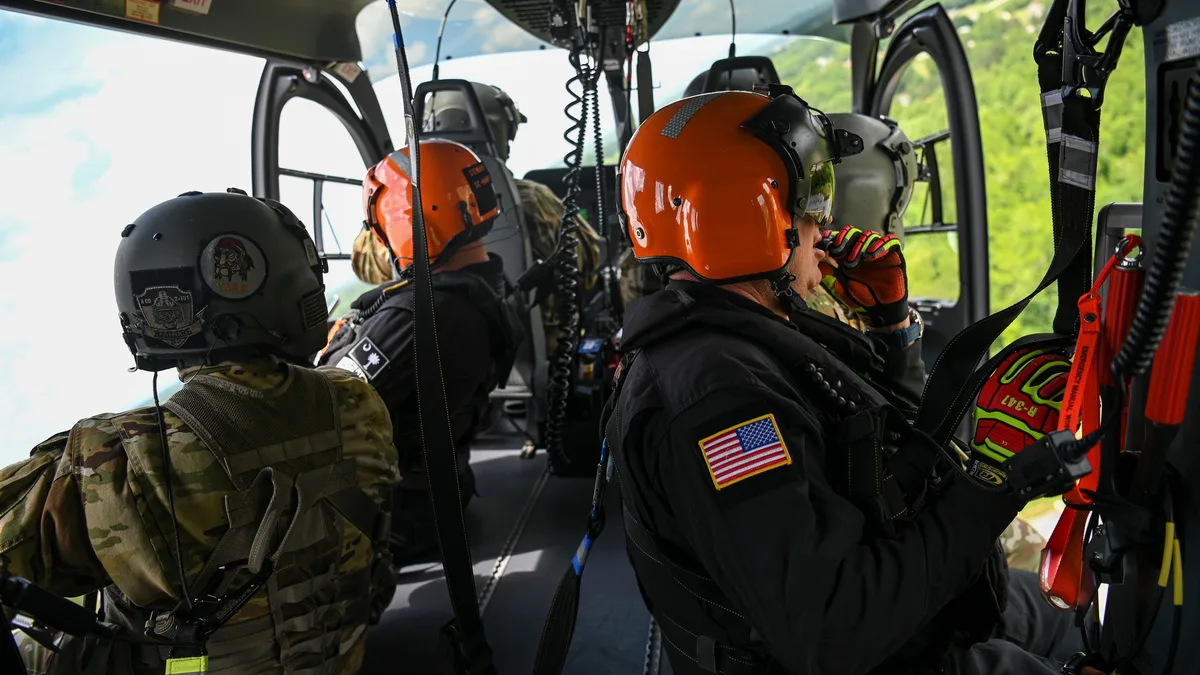
Photo: U.S. Army National Guard / Pfc. Ana-Grace Catoe via DVIDS. File photo of hoist training aboard a South Carolina Guard UH-72B Lakota (an H145 variant), not the French aircraft or incident.