
The Federal Communications Commission has changed the rules for a small slice of spectrum near 450 MHz so it can carry control links for drones and other flight-safety data. The Report and Order, FCC 26-81, was adopted November 19, 2026, and released November 20.
What changes in the 450 MHz band
The band covers 454.6625-454.9875 MHz and 459.6625-459.9875 MHz. Until now, the old site-by-site rules limited it to voice calls with general aviation aircraft at high altitudes. The FCC said that effectively ruled out data links and wide-area coverage down low.
The new rules allow uncrewed aircraft control and non-payload communications (CNPC) and other flight-safety data at a range of altitudes, including lower ones. They do this under a single geographic license that covers the whole country. The FCC said the band can now be one option for local, regional and national drone networks and for advanced air mobility (AAM). It noted that future eVTOL aircraft with pilots on board may also need ground links.
AURA Network Systems, the band’s only licensee, had asked the FCC to update the rules. It welcomed the decision the same day.
Two other changes
The same order allows ground-based radar for detecting drones in the 24.45-24.65 GHz band. It also updates power rules for commercial in-flight broadband air-ground systems at 849-851 MHz and 894-896 MHz.
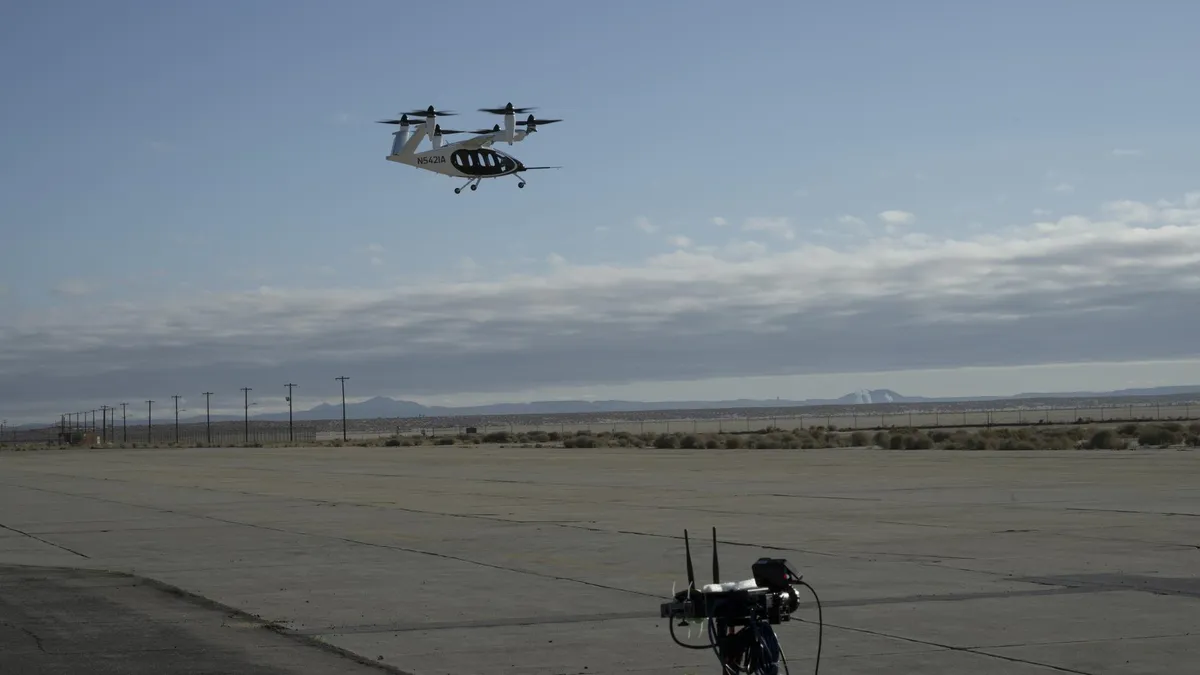
Photo: NASA / Genaro Vavuris. File photo: a NASA ground sensor node during air taxi research with a Joby aircraft near Armstrong Flight Research Center, March 2025.